
Breast pumping

Here’s what you need to know for breast pumping
at home, at work or on the go

Why does a good flange fit matter and how can I get it?

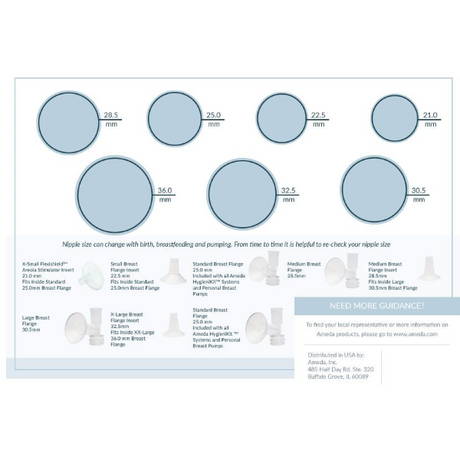
Every mother needs a good flange fit for greater comfort and better milk flow. What determines a flange’s size—and your fit—is the width of its opening. To get an idea of your flange size, compare your nipple to a US nickel. If your nipple is wider than a nickel, you will likely need a larger-than-standard size breast flange. But because the breast changes as you pump, measuring tools alone are not the most reliable gauge.


The best way to check your fit is to watch your nipple during pumping. With a good fit, you should see space around your nipple as it moves freely in the flange’s tunnel (see below Photo A). With a tight fit, your nipple may rub along the tunnel’s sides or move very little (see below Photo B). A tight fit squeezes the nipple and slows milk flow. The rubbing can also cause discomfort, skin irritation, and skin breakdown.


PHOTO A: GOOD FIT

PHOTO B: TIGHT FIT

A pump flange can also be too large. In this case, more than about ¼ to 1/8 of an inch (3-6 mm) of the area around your nipple will be pulled in as you pump or your nipple may appear to bounce in and out of the nipple tunnel.

If your flange is too large or too small, you may feel discomfort even on low suction settings. You may also pump less milk than expected.

But once you find a good flange fit, this isn’t the end of the story. Flange fit can change with birth, breastfeeding, and pumping. The flange that fits you well when you start pumping may need to change as you pump longer. For this reason, it makes sense from time to time to recheck your flange fit.

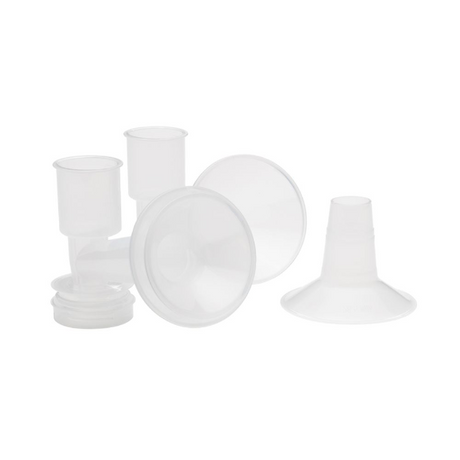
Ameda offers seven flange sizes. Some Ameda pumps and kits include multiple flange sizes. If the size you need is not included in your package, contact your Ameda retailer. All of the sizes below are available for purchase.

This is general information and does not replace the advice of your physician or healthcare provider. If you have a problem you cannot solve quickly, seek help right away.

Every baby is different, and your baby may not be average.
If in doubt, contact your physician or other healthcare provider.


Nancy Mohrbacher, IBCLC, FILCA, Lactation Consultant, Ameda Breastfeeding Products
Coauthor of Breastfeeding Made Simple: Seven Natural Laws for Nursing Mothers

Breastfeeding -The basics

Learning to nurse your newborn is like learning to dance with a new partner. You have to find your rhythm and pace, and then you and your baby will be in the groove.  Learn more

Breastpumping tips

One of the best ways to learn about breastfeeding is from other mothers...

Don’t wait to breastfeed until your breasts feel full...

After birth, lots of breastfeeding brings in more milk faster...

Feeding amounts will vary by your baby’s age...

Write the date and time on your milk container...

Your milk is not “homogenized” like the milk in the store...

If you combine milk from different days, use the date of the oldest milk...

Store your milk in amounts no larger than what your baby might take...

Any clean, sealed container can be used to store milk...

Pump 30-60 minutes after a nursing and at least an hour before a nursing...

Try pumping in the morning. Most women get more milk then...